
As someone whose career is involved in classical music and education, one of my goals is to bring attention and appreciation to music. However, I understand that newcomers can find difficulty in approaching classical music. One of the big barriers to classical music is understanding the structure of titles. Titles given by composers and publishers can be different from popular nicknames. For example, most people don’t recognize the title Beethoven’s Piano Sonata No. 14, Op. 27 No. 2. A few more people might know it by his official designation to the piece, Quasi una Fantasia, and mostly everyone knows it by its unofficial title, Moonlight Sonata, which was not even nicknamed by Beethoven himself. As another example, many people know that “Ode to Joy” is from Beethoven, but would not know it was from a section from his Ninth Symphony in d minor, Op. 125 ‘Choral.’
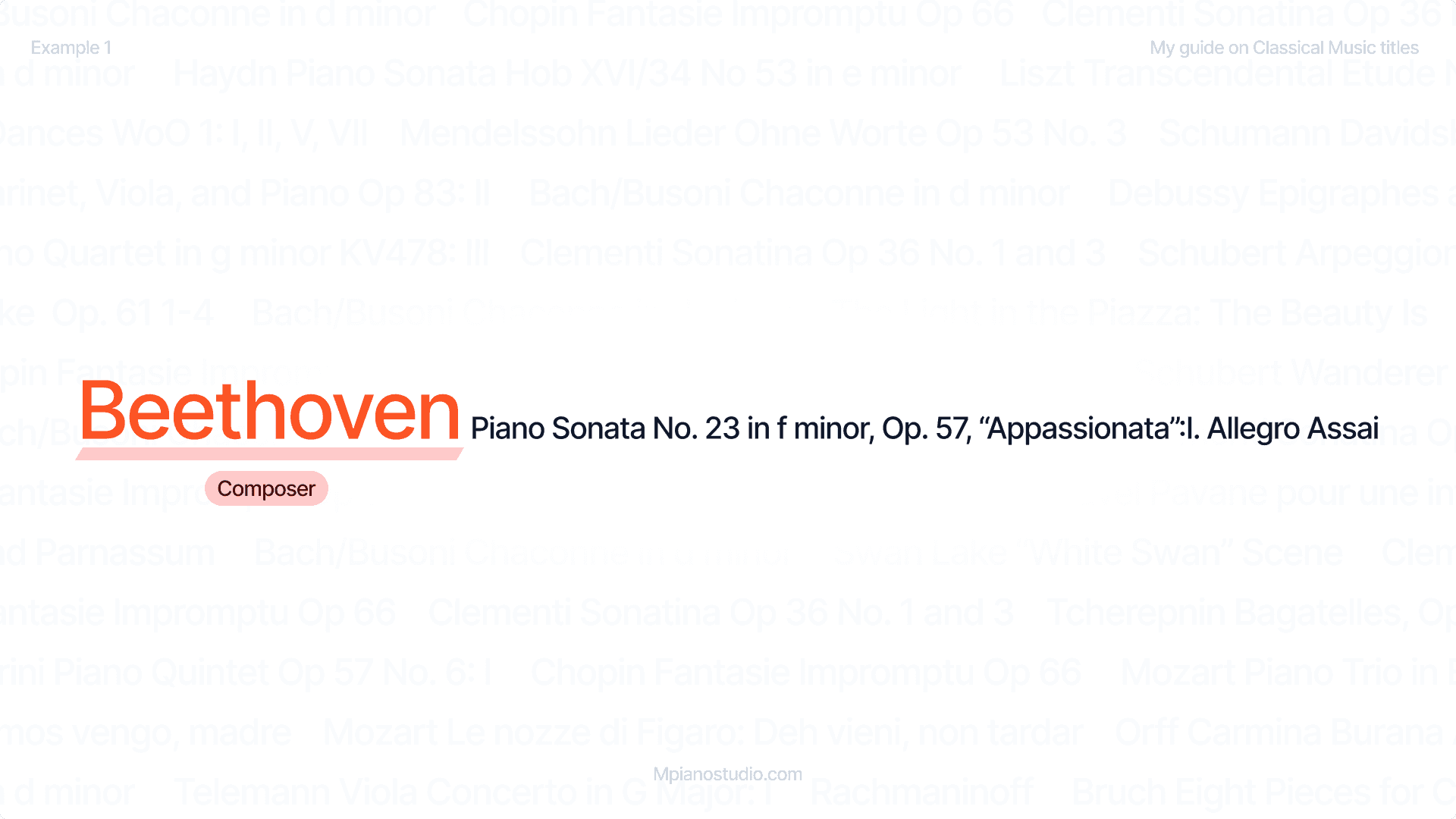
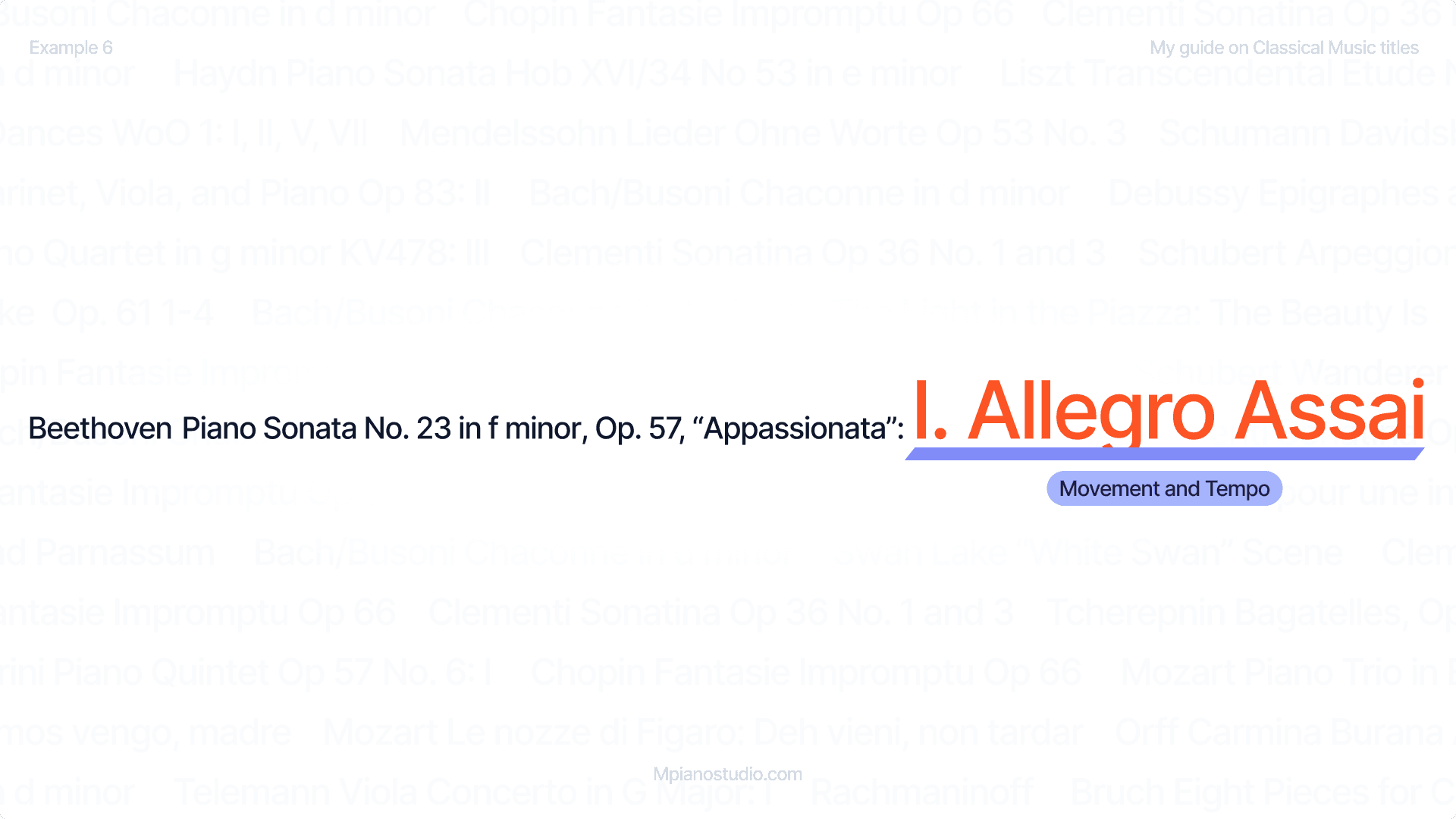
In this guide, I will break down these titles and how they’re made to make classical music more accessible. At the end of each section, I will use a visual with “Beethoven Piano Sonata No. 23 in f minor, Op. 57 Appassionata: I. Allegro Assai” to highlight each part of the title. I cannot pretend to know everything, so if you know something I did not cover, I invite you to reach out so I can include it in this guide. Hopefully after reading this guide, you’ll reach a better understanding of titles to both recognize and look for classical music.
Composers
The very first part of understanding titles is the composer, which is very obvious. However, one misunderstanding comes from the fact that there are composers who share the same last name. For example, Leopold Mozart and his son, Wolfgang Amadeus Mozart, or Robert Schumann and his wife, Clara Schumann. Most of the time, we refer to a work by the composer’s last name, so if you hear Bach’s Solfeggio in c minor, make sure you know it’s Carl Phillip Emmanual Bach, and not his father, Johann Sebastian Bach. Looking up “JS Bach Solfeggio” might lead to Google correcting your search to CPE Bach instead, but it may not work with every case.
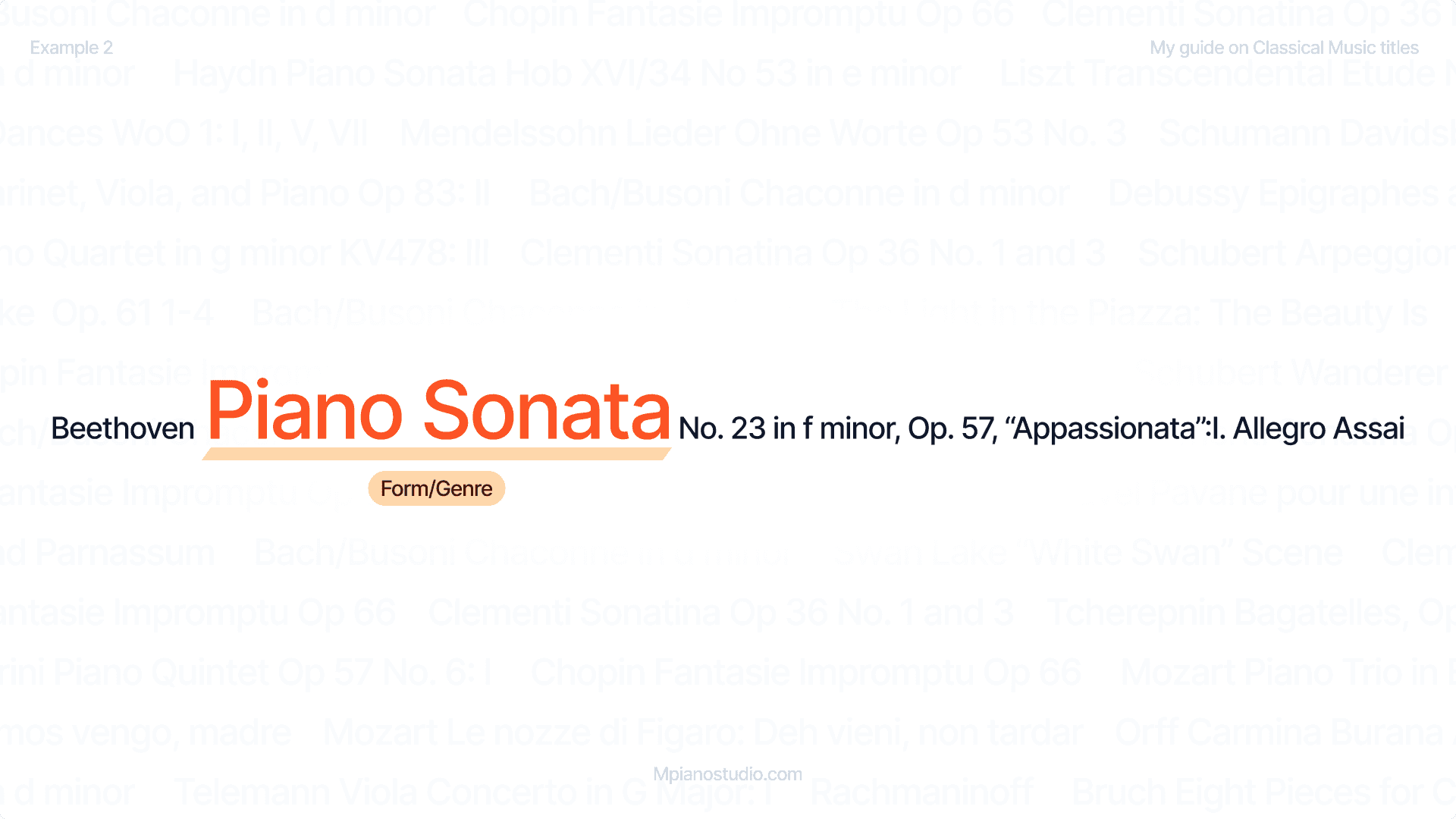
Form/Genre
The next big identifier is the form. Form can relate to the instrument(s) and/or voices used, but more importantly, it relates to the type of composition. Concertos (pieces that are meant for solo instruments accompanied by an orchestra) are different from sonatas (instrumental works for a solo instrument, sometimes accompanied by piano) and from suites (a collection of various short works, often dances). These are a few examples of forms in classical music. Compositions with the same form are numbered chronologically by publication date. Chopin wrote 21 nocturnes, and each is numbered by when it was published.
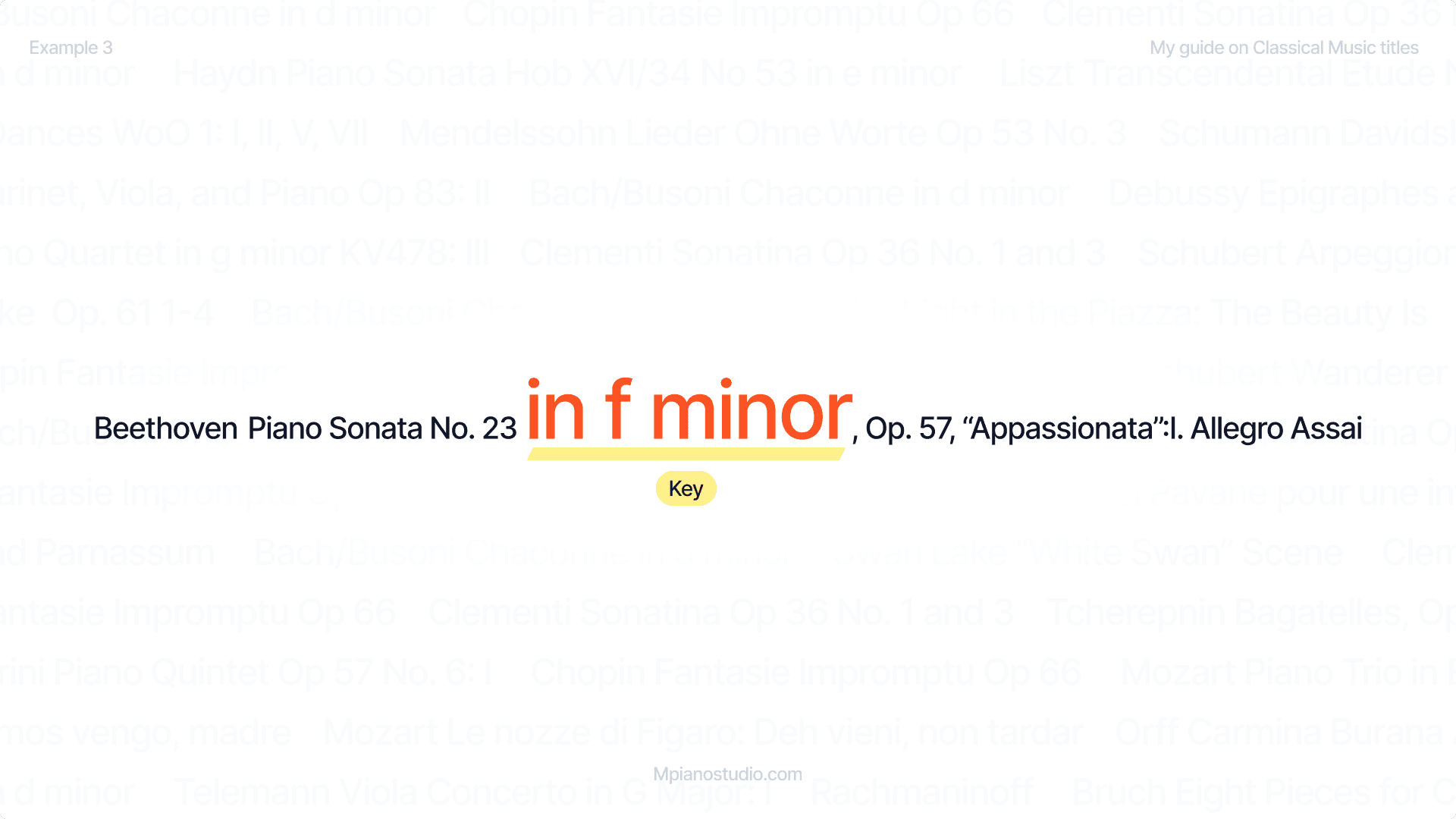
Keys
The next part of the title is the key of the piece. The key of a piece of music is essentially a specific collection of notes and gives stability to the note it's named to. This article is not meant to go over any music theory, so I won’t go into much of the specifics. At first, the key won’t give you too much information other than identity, but over time, you’ll be able to expect certain emotions from specific keys. In the baroque era, it was standard practice for composers to write in keys to evoke specific emotions. For example, Bach’s Prelude and Fugue in C Major, BWV 846 uses its key to portray simplicity and purity. To reference keys, we use one of the notes of the musical scale, then conclude it with either major or minor. Examples being f minor, A-flat Major, or G Major.
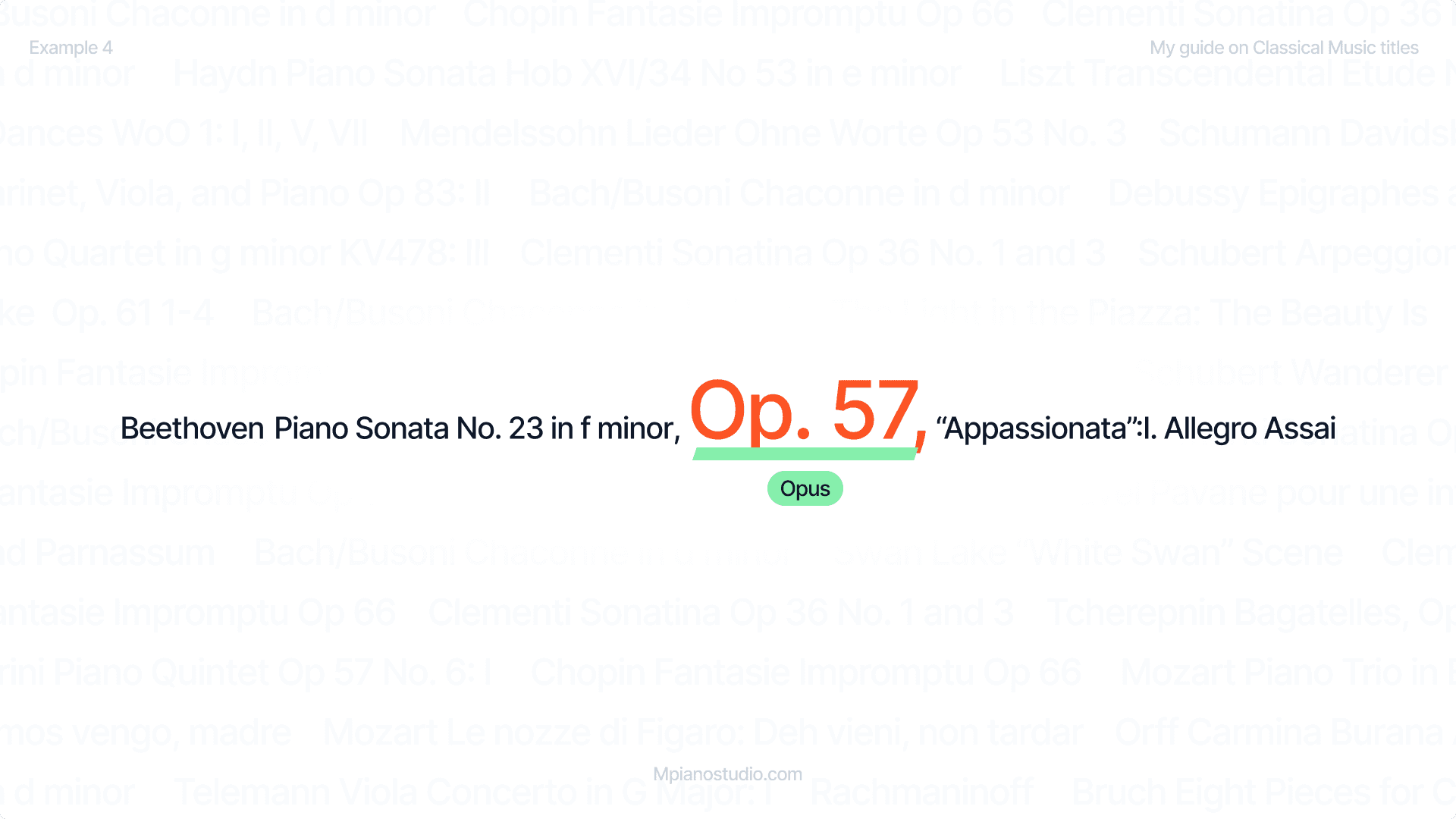
Opus
After composer and form, the opus is the most important part of the title. The opus is essentially the chronological order of all the composer’s published works, which is different from compositions being numbered by form. Composers are also able to group works together and release them as one opus. For example, Chopin released three nocturnes for opus 9, then three more for opus 15. We can identify the fourth nocturne as Chopin Nocturne No. 4, but an alternative title for this same nocturne is Chopin Nocturne Op. 15 No. 1, because it was the first of the three nocturnes Chopin published in his Op. 15 collection.
There are some works without an opus number, which is referred to as WoO. Beethoven for example has many works that he did not publish or finish, so those are often referred to as WoO, or Werke ohne Opuszahl, which conveniently translates to Works without Opus. For example, Beethoven wrote three piano sonatas when he was a preteen, dedicating them to Maximilian Friedrich. They were not published, so they are not included in the 32 piano sonatas most publishers now print. The three piano sonatas all were grouped under WoO 47. So formally, his first piano sonata that most publishers will print it as, Op. 2 No. 1 was actually the fourth piano sonata he’s written. It’s this reason why some musicians will refuse to use form numbers and use the more accurate opus numbers instead, and justifiably so.
Catalog Numbers
Catalog numbers are especially made for works and composers who don’t have an opus, but can still exist for those who do. In the case of Schubert, his works have an opus number, and also have a catalog letter D, set by Otto Erich Deutsch. The reason for this is that opus numbers are really set by publishers, and if a composer doesn’t release their works or some of their works to be published, the chronological can be hard to follow.
The most famous composers who have catalog numbers are Bach and Mozart. Bach uses BWV, known as Bach Werke Verzeichnis (Bach Works Catalog), and Mozart uses K, or KV, which stands for Kochel Verzeichnis (Kochel Catalog, compiled by Ludwig Ritter van Köchel). Bach’s famous Prelude in C Major is BWV 846. Almost every piano student plays Mozart’s Piano Sonata No. 16, which is KV 545.
A great example to understanding why cataloguing is important in classical music is Haydn. He does have an opus set by different publishers, but it is too inconsistent due to duplicate opus numbers and did not cover all his works. Anthony van Hoboken devised his own catalog, abbreviated as Hob, and is now the standard way of categorizing his works. His catalog is organized by musical genre, and uses roman numerals. For example, his piano sonatas are given the numeral XVI. His famous e minor sonata is formally known as Haydn Piano Sonata in e minor, Hob.XVI:34.
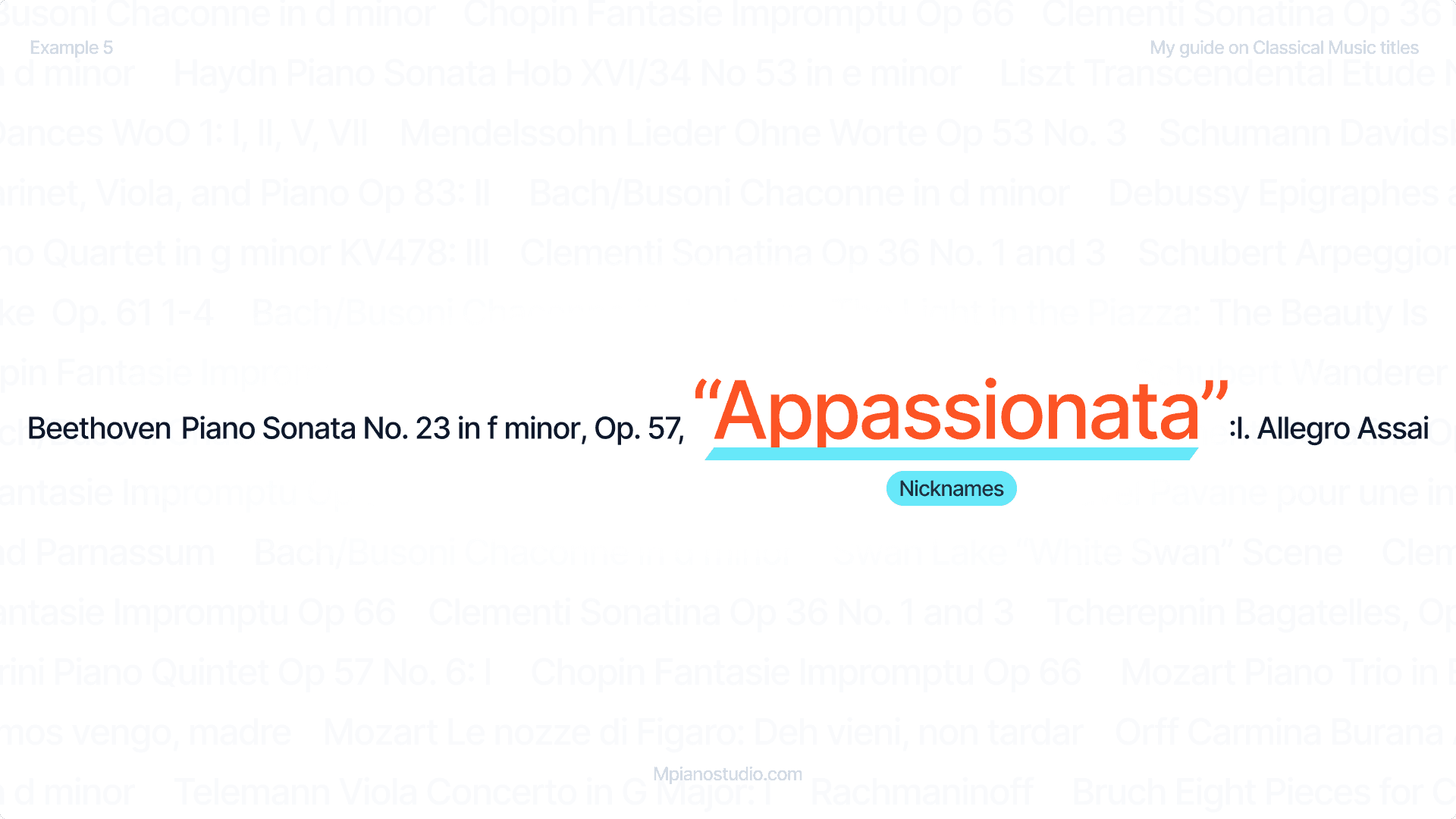
Nicknames
As I mentioned in the introduction, Beethoven’s Piano Sonata Op. 27 no. 2 has a name given by Beethoven, Quasi una fantasia, and one by Ludwig Rellstab, Moonlight Sonata. This is a rare case, but in the classical period and after, composers started giving programmatic names to their pieces to describe their pieces. These names could be added onto the end of titles, or be used exclusively, like Rimsky-Korsakov’s Scheherazade or Ravel’s Gaspard de la Nuit. In these cases, there is nothing else to add to these titles as these names are enough to reference these works.
Movements and Tempo
The last part of a title you’d need to know are movement names and tempo markings. Most of the time, movements are referred to with their tempo markings. Movements are essentially parts of a larger work, and should be heard in order. Tempo is the speed of the piece, and frequently uses Italian terms. There are some cases where additional musical direction is written.
Using Beethoven’s first symphony as an example, here’s how a programme with his first symphony would be structured.
Symphony No. 1 in C Major, Op. 21
I. Adagio molto - Allegro con brio “Fast with vivacity/liveliness”
II. Andante cantabile con moto “Moderately slow, singing with motion”
III. Menuetto. Allegro molto e vivace “Very fast and lively”
IV. Finale. Adagio - Allegro molto e vivace “Slow - very fast and lively”
Adagio - Allegro molto e vivace is marked because the first five measures are marked in Adagio while the rest is marked Allegro molto e vivace.
If you’re looking for a specific movement, it is enough to google “Beethoven Symphony 1 Movement 3,” and the tempo indication is not needed.
Some movements are not named by their tempo indications. For example, Claude Debussy wrote a piano suite named Suite bergmasque, and its third movement is titled Clair de lune. In the baroque era, composers like JS Bach and Handel used dance movements in their suites, and used their characteristic names, such as Sarabande, Allemande, Courante, and Gigue.
Choral works, Song Cycles, and Opera
Song cycles are collections of songs meant to be performed in sequence. The structure for song cycles and choral works is similar to its piece counterpart. The name of the song cycle replaces the form, and each song takes place of where the movement would be. For example, Schubert Winterreise Op. 89: No. 5 “Der Lindenbaum”
Winterreise is the song cycle, and “Der Lindenbaum” is the fifth song in the cycle.
An opera will be first divided into Acts, then specific sections which include preludes, overtures, choruses, and arias. Roles of the cast involved in these sections can be included at the end in parentheses. Wagner: Tannhauser, Act 1 “Naht euch dem Strande!” (Sirenen)
Exceptions and Misc. Info
I want to list a few exceptions and extra information that might be interesting to know.
First is Tchaikovsky’s Opus 37a and 37b. Opus 37a refers to his The Seasons, and Opus 37b refers to the Grand Sonata. This is because he sent these two works to two different publishers, both of whom used Opus 37, although he sent The Seasons a year after he sent in his Grand Sonata. Publishers later revised this issue by using A and B.
Posthumous works are pieces that are published after a composer’s passing. Chopin had many posthumous works, most of which are waltzes. These pieces would be marked as Op. Posth, or with the catalog letter B, set by Maurice J. E. Brown.
Some composers like Schumann, Bach and Beethoven have had an appendix, known as Anhang. The anhang section of published scores includes sketches that were unfinished, alternate readings, or related works of dubious authenticity. In JS Bach’s Notebook for Anna Magdalena Bach, the famous G Major minuet is titled BWV Anhang 114, due to the fact that it was later found out that JS Bach did not compose it. Court organist Christian Petzold did, but it is still included in this publication by JS Bach.
Over time and with experience, understanding classical music titles should become very easy. I hope reading through this very thorough guide helps you understand the structure behind classical music titles and makes classical music more accessible to the general public.