

Urtext editions are performing editions that convey the composer’s original intent as much as possible by using original notes and markings. They are reproductions, and not facsimiles, which are photocopies of the original manuscript, handwritten by composers.
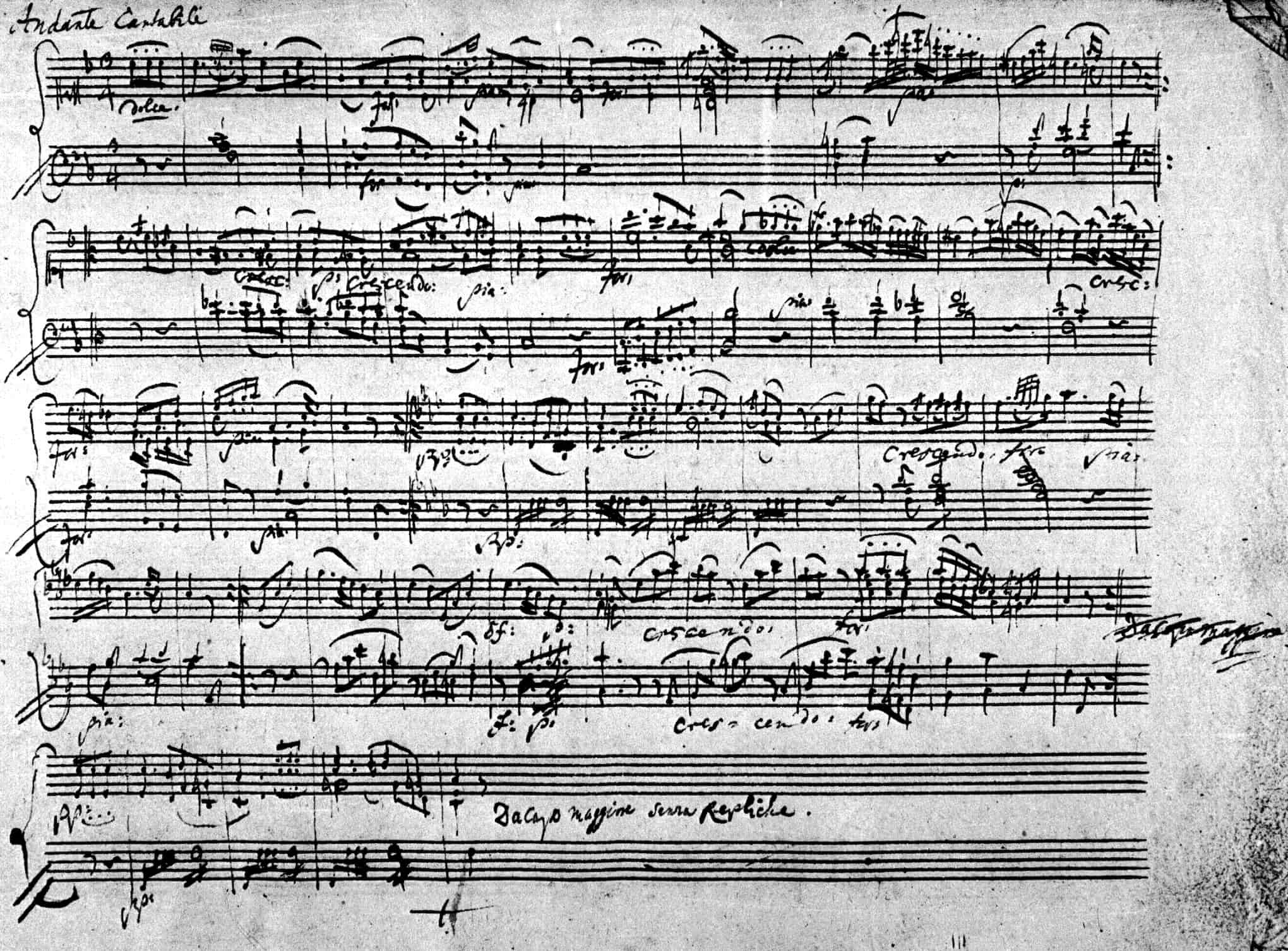
Mozart, Wolfgang Amadeus. Piano Sonata in C KV 330, 2nd Movement:Andante Cantabile
Urtext editions research and print the score with pertinent markings after considering several sources including composer manuscripts, first editions and subsequent editions, their students’ copies, and any written records that mention the works, such as letters. Interpretive changes and additions are omitted, or in some cases, are specifically distinguished with italics, smaller font, or parenthesis. These additions may be based on students’ copies or later re-releases of the same piece. In this example of a Mozart sonata, see the font size difference in dynamics.

Mozart, Wolfgang Amadeus. Piano Sonata in C KV 330, 1st Movement:Allegro moderato. Edited by Wolfgang Plath and Wolfgang Rehm. Bärenreiter Kassel, 2021
Which publishers have urtext editions?
The most common urtext editions used by students and performers alike are published by Henle. Henle only publishes urtext editions, and so does Barenreiter and Wiener. Other publishers have urtext editions as well as edited scores, such as Edition Peters and Breitkopf & Hartel. Urtext editions will have the word urtext on the cover, which is a great way to tell if you are looking at an authoritative copy or not.
Are there any cons of purchasing urtext editions?
The main con of purchasing urtext editions is the cost. There is huge value in purchasing edited music since there isn’t as much care or research put into them. For example, Schirmer has an ultimate Chopin collection which includes Mazurkas, Ballades, Etudes, Nocturnes, Polonaises, Preludes, and Waltzes. At the time of writing, this book is $31.80. Meanwhile, purchasing these all from Henle would be $245.55.
Why are Urtext editions important?
Edited music contains too much bloat and unnecessary interpretive additions. Students who follow edited music will follow all the markings, and will not be able to distinguish between what’s original and what’s added/changed by editors. Urtext editions can ensure that the player follows exactly what was written and only what was originally written. They will then have the freedom of interpreting and researching the music further.
Urtext editions also have a preface that gives historical information about the composer and the piece it presents. This is not unique to Urtext editions, but the research presented is generally higher quality than other editions that also have a preface. A commentary is also written at the end which will discuss changes/extra markings that may have occurred in students’ copies given to them by the composer, or changes and corrections they might have made in previous or revised publications of the same work.
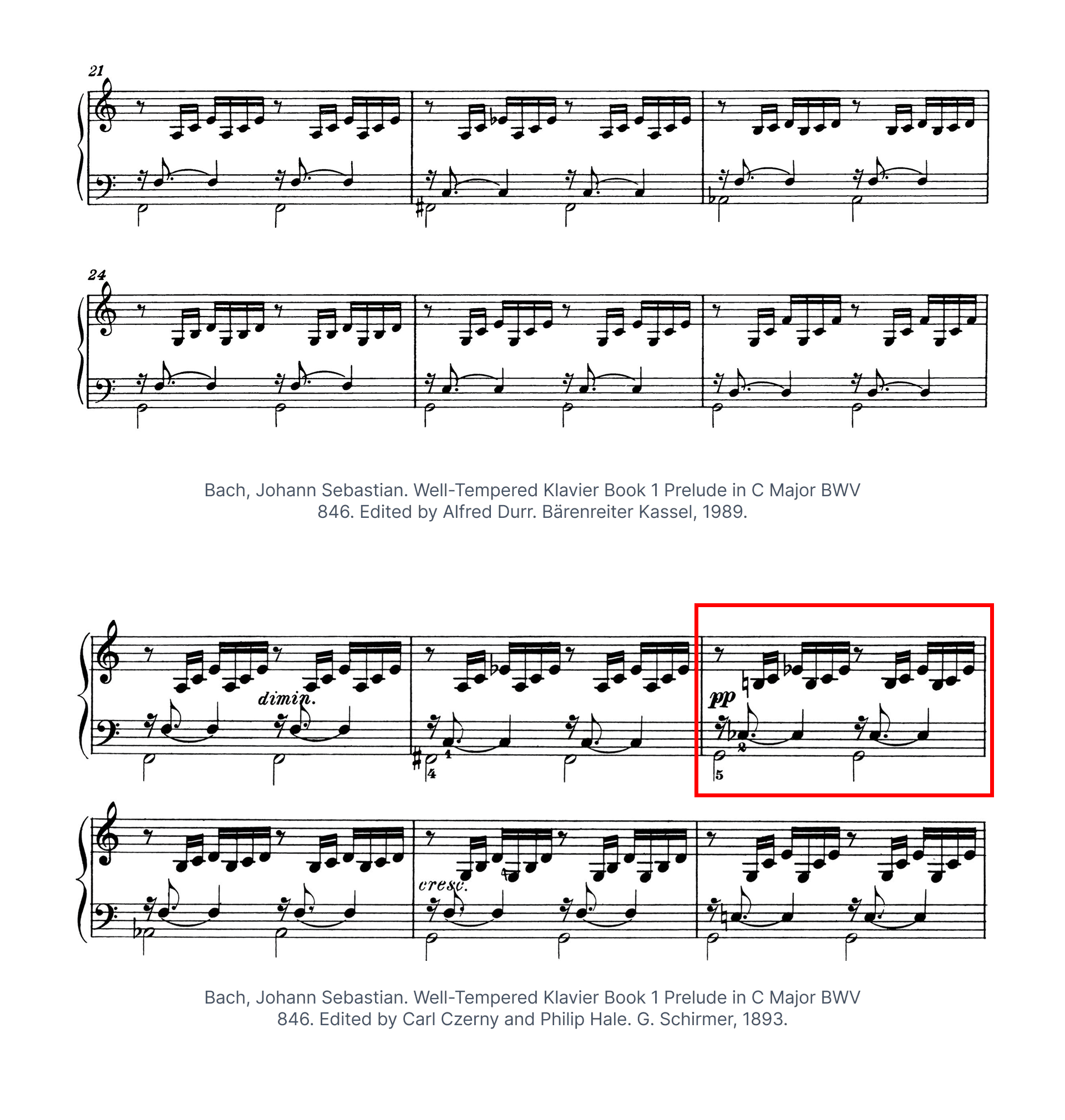
I will use Bach’s Well-Tempered Clavier, Book I, Prelude in C Major as an example of a comparison between an Urtext and an edited edition. Below are two scans, one from Bärenreiter-Verlag published in 2020 and one from Schirmer published in 1893. The Schirmer edition is a reproduction from Edition Peters, originally edited by Carl Czerny, a pianist, pedagogue, and composer who studied Bach’s preludes and fugues with Beethoven. Czerny’s edition reflects his interpretation of the music, adding dynamics, phrasing, and articulation markings that are not found in Bach’s original score.
Aside from the extra markings from Czerny, a striking difference is the highlighted additional measure shown in the Czerny example is not present in the Barenreiter edition. The added measure smooths the voice leading in the bass: instead of moving directly from F-sharp to A-flat, as Bach wrote it, the bass moves from F-sharp to G and then to A-flat. Czerny’s version may sound smoother and more conventional, but Bach’s original F-sharp-to-A-flat motion is considerably more striking. Most importantly, the additional measure does not appear in Bach’s autograph manuscript. It was introduced by copyist Christian Schwencke, and thus this extra measure is known as the ‘Schwencke’ measure. It is not clear whether he found this measure in an inauthentic copy or composed it himself when he edited his copy. This comparison demonstrates the value of an Urtext edition: it gives performers confidence that the composer’s work has not been enhanced with editorial dynamics, articulations, or expression markings, or altered to conform to the musical style and performance practices of a later period. The performer can therefore approach the score knowing that it reflects the most authentic version of the composer’s original notation available.
I believe that despite the cost, it is important to obtain or have access to urtext editions. We as musicians spend hours and hours practicing our pieces, and I think it’s worth having the best tools available to us to have the closest connection to the piece and the composer to portray their work.
Urtext editions are especially important for students who want to pursue higher education and go for competitions, as judges and international faculty value accuracy. I have seen two instances, one to myself, where a better edition was highly suggested. In my case, when I was studying Chopin’s 4th Ballade, a professor told me even the henle urtext edition wasn’t good enough, and asked me to use the Polish National Edition instead, which is the recommended edition for pianists participating in the International Chopin Piano Competition.
I value the transparency that urtext editions provide. The materials used are also much higher quality, and page turns are well thought out. Some editions have fingerings from well respected pianists as well, while Barenreiter offers editions with no fingerings written in. As a teacher, having urtext scores that I can personally use, and also use to teach my students is invaluable since I can rely on them. Otherwise, time could be wasted comparing edited music to a more accurate source. However, since urtext scores are not the original manuscript, there is no “best” urtext edition. Editors will choose between readings and sources to add/exclude material and markings, but will do their duty to explain their reasonings. It is then up to the musician to read and consider what to use in their performances.